-
Xinzhen Town Industrial Zone, Wen'an County, Langfang City, Hebei Province

Trough Type Cable Tray: When Maximum Cable Protection Matters
Recent News
View Products
Contact Us
Table of Contents
When you are planning a cable management system, the question is not only how to route cables efficiently but also how to protect them over the entire lifecycle of your facility. In environments where dust, moisture, oil mist, or mechanical impact are real risks, open cable tray systems often fall short.
This is where the trough type cable tray becomes a practical and reliable solution.
Unlike ladder or wire mesh cable trays, trough type cable trays use a fully enclosed structure formed from a single steel sheet, creating a protective channel that shields cables from external interference. If your priority is protection, organization, and long-term reliability, this system deserves serious consideration.
This guide is written to help you understand when trough type cable trays are the right choice, how they are designed, how to specify them correctly, and how they perform in real projects—so you can make informed decisions with confidence.
What Is a Trough Type Cable Tray?

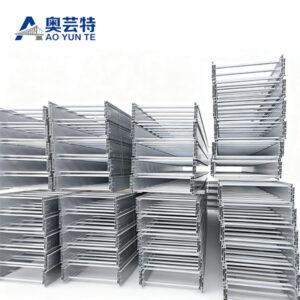
A trough type cable tray is a channel-shaped cable support system formed from a single sheet of steel. The structure resembles a trough or enclosed channel and is designed to support, protect, and organize cables, conductors, and small pipelines.
Structural Characteristics
- Formed from one continuous steel plate
- Enclosed or semi-enclosed profile
- Smooth internal surface for cable protection
- Optional covers for full enclosure
Because of its structure, a trough type cable tray offers significantly higher environmental protection compared to open tray systems.
Why Trough Type Cable Trays Exist
Cable tray systems evolved to solve different problems. Ladder trays prioritize ventilation, wire mesh trays prioritize flexibility, and trough-type trays prioritize protection.
You should consider trough type cable trays when:
- Cables must be isolated from dust, moisture, or oil
- Mechanical impact or falling debris is a concern
- Cable organization and separation are critical
- Maintenance access is controlled rather than frequent
In short, this system is designed for controlled, protected cable routing, not constant reconfiguration.
Protection Advantages of Trough Type Cable Trays
1. Superior Environmental Isolation
The enclosed design helps isolate cables from:
- Dust and particulate buildup
- Water vapor and condensation
- Oil mist and industrial pollutants
- Accidental mechanical contact
This makes trough-type cable trays especially suitable for industrial production areas, equipment rooms, and utility corridors.
2. Mechanical Impact Resistance
Because the tray walls surround the cables, they provide a physical barrier against impact, reducing the risk of insulation damage caused by tools, falling objects, or vibration.
3. Improved Cable Organization
The channel structure keeps cables aligned and prevents lateral movement, which helps maintain:
- Consistent bending radius
- Clear separation between cable groups
- Long-term system neatness
How Trough Type Cable Trays Are Manufactured
Most trough-type cable trays are manufactured by forming a single steel sheet through bending or roll-forming processes.
Manufacturing Process Overview
- Steel sheet is cut to required width and thickness
- Sheet is formed into a trough profile
- Edges are reinforced or flanged for strength
- Surface treatment is applied (galvanizing, coating, etc.)
This one-piece construction reduces weak points and ensures uniform structural performance along the entire tray length.
Material Options and Surface Treatments
Although steel is the most common base material, different surface treatments allow trough-type trays to adapt to various environments.
| Material / Finish | Typical Application | Key Benefit |
|---|---|---|
| Pre-galvanized steel | Indoor dry areas | Cost-effective |
| Hot-dip galvanized | Humid or industrial areas | Enhanced corrosion resistance |
| Powder-coated steel | Clean rooms, equipment rooms | Aesthetic + protection |
| Stainless steel | Highly corrosive environments | Maximum durability |
Load Capacity and Structural Performance
Trough-type cable trays are known for their high load-bearing capacity, thanks to their closed-channel geometry.
| Tray Width | Typical Load Capacity | Recommended Span |
|---|---|---|
| 100–200 mm | Medium | 1.5–2.0 m |
| 300–400 mm | High | 2.0–2.5 m |
| 500+ mm | Very high | 2.5–3.0 m |
Because the structure behaves like a beam, trough-type trays can support heavy cable bundles with fewer supports when properly specified.
Trough-Type vs Other Cable Tray Systems
| Feature | Trough-Type Tray | Ladder Tray | Wire Mesh Tray |
|---|---|---|---|
| Cable protection | Excellent | Moderate | Low |
| Ventilation | Low | High | Very high |
| Mechanical resistance | High | Medium | Low |
| Maintenance access | Controlled | Easy | Very easy |
| Environmental sealing | Excellent | Poor | Poor |
Key takeaway: If protection matters more than ventilation, trough-type trays are often the better choice.
Installation Best Practices

Route Planning
Before installation, you should:
- Identify areas with high dust, moisture, or impact risk
- Plan straight runs to minimize joints
- Allocate inspection access points
Support Spacing
Because trough-type trays carry heavier loads, support spacing must be carefully calculated.
- Do not exceed manufacturer-recommended spans
- Reinforce supports near bends or vertical drops
- Ensure structural anchors can handle combined load
Cable Laying
- Avoid overcrowding the tray
- Maintain minimum bending radius
- Use separators if multiple cable types share the same tray
Real-World Application Example
Scenario: Industrial Equipment Hall
An equipment hall experienced frequent cable failures due to oil mist and airborne dust settling on open ladder trays.
Challenges identified:
- Dust accumulation on cable insulation
- Oil contamination accelerating insulation aging
- Accidental contact during maintenance
Solution implemented:
- Replaced ladder trays with trough type cable trays
- Added removable covers for inspection access
- Reorganized cable routing into functional groups
Results:
- Significant reduction in cable contamination
- Improved safety during maintenance
- Lower long-term replacement frequency
This type of environment is where trough-type cable trays consistently outperform open systems.
Fire Safety Considerations
While trough-type trays are enclosed, fire safety still depends on:
- Proper material selection
- Use of fire-rated coatings where required
- Maintaining clearance from heat sources
In fire-sensitive environments, trough-type trays are often used alongside composite or fire-retardant cable tray systems.
If you are evaluating enclosed steel or fiberglass trays for environments with high dust, moisture, or chemical exposure, you may also want to consider composite cable trays: a practical solution for demanding environments. These composite solutions, like fiberglass trays, offer excellent corrosion and fire resistance, providing a reliable alternative for long-term cable protection.
Maintenance and Inspection Strategy
Although trough-type trays reduce environmental exposure, periodic inspection is still recommended.
- Check for condensation or moisture buildup
- Inspect covers and fasteners
- Verify cable insulation condition
Proper maintenance ensures the tray remains a protective system rather than a closed trap.
Cost Perspective: Protection vs Flexibility
| Cost Factor | Trough-Type Tray | Open Tray |
|---|---|---|
| Initial material | Moderate | Lower |
| Installation | Moderate | Lower |
| Maintenance | Low | Higher |
| Cable lifespan | Longer | Shorter |
| Total lifecycle cost | Competitive | Often higher |
For environments with contamination risks, the higher protection level often offsets the initial cost difference.
Common Mistakes to Avoid
- Using trough-type trays where ventilation is critical
- Overfilling enclosed trays
- Ignoring moisture management
- Selecting insufficient corrosion protection
Conclusion
A trough-type cable tray is not designed to be the most flexible or open system—it is designed to be protective, structured, and durable. When your cables face environmental exposure, mechanical risk, or contamination, this system offers a level of security that open trays simply cannot match.
FAQ
Are trough-type cable trays fully enclosed?
They are typically enclosed or semi-enclosed and can be fitted with covers for full protection.
Can trough-type trays be used outdoors?
Yes, when properly galvanized or treated for corrosion resistance.
Are trough-type trays suitable for power and control cables together?
Yes, with proper separation or internal dividers.
How do trough-type trays compare to conduit systems?
They offer easier installation and maintenance while still providing strong protection.
When should trough-type trays be avoided?
In environments where heat dissipation or frequent cable changes are required.
Need Help Selecting the Right Trough-Type Cable Tray?
If your project requires maximum cable protection and long-term reliability, our technical team can help you specify the right trough-type cable tray system for your environment.
Contact us today to get expert guidance and build a cable management solution that truly protects your investment.